
by Romy Beckman
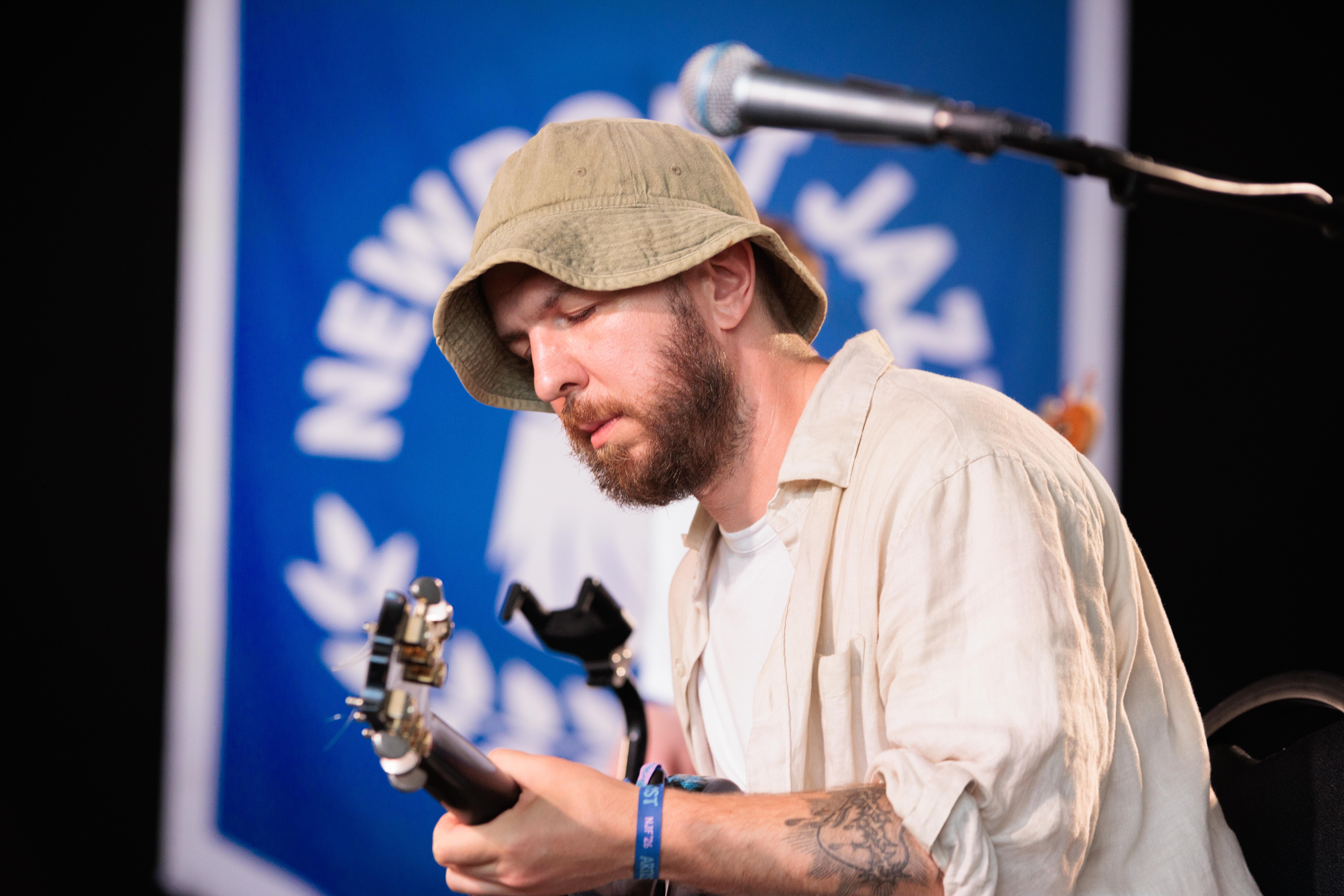
Joe Harris (guitar) and Tom Henry (keys) of Gotts Street Park made the trip all the way from Leeds, UK to perform at the 2026 Newport Jazz Festival. The morning of their 5pm set on the Harbor Stage, I spoke with them for a few minutes about their upcoming album, Somewhere Between, their creative process, and their reverence for Jazz and its legacy.

Romy Beckman: This is your first time at Newport, right? How has it been so far?
Joe Harris: Yeah. I mean, the history of it, in the dressing room seeing photos and Miles and Coltrane… We were just saying it’s so overwhelming—just the history here and the people that have passed through.
Romy: Playing at such a legendary and historic venue, what sort of feelings come up around that?
Joe: Yeah, it’s an honor, and like I said, overwhelming, definitely. I think there’s too much that’s happened here, you know? There’s a lot of musicians who’ve had a big impact on me personally, and all the band in different ways. Yeah, just to kind of be on the ground where some of them trod, it’s really special.
Tom Henry: Yeah, I can’t really add to that. Just trying to take it all in.

Romy: Your music incorporates a lot of elements and conventions of different genres, but here we are at the Newport Jazz Festival. So I wanted to ask what jazz means to you. And the history of jazz and the conventions of jazz, how have they influenced your music?
Tom: We met playing jazz, really. We both studied jazz in Leeds. I wouldn’t say the band is a jazz band necessarily, but there’s elements of improvisation in there. And when it comes to writing, we improvise during the writing stage and a lot of our ideas come from improvisation. Whether it’s just someone coming up with an idea on the spot and then that gets worked on as a unit. But yeah, there’s very rarely predetermined ideas. It’s just often just spontaneous things happening in a room and then we record and then listen back and then decide where to go from there.
Joe: I think the love of improvisation has carried through strongly, directly from jazz, really. As a guitarist, I was playing blues before jazz. You can separate all this stuff if you want but it informs each other, you know. It’s all part of a grand history that’s in some way impacted me.
Romy: You’ve spoken a lot about improvisation. The set that you’re performing this evening, how much are you going to be improvising on stage?
Tom: We play set material, like the songs are all there. So there’s not—I mean, compared to a jazz show—there’s not a huge scope for improvisation, it comes in moments with solos. And sometimes with the speed we feel like playing the tune. So it’s in smaller ways and in pockets. But definitely for solos and instrumental moments, they’re always different, the vibes are different, it’s on the fly. One part could be thirty seconds one night and two minutes another night. So yeah, in more subtle ways, just keeping that element in there and stepping into the unknown a little bit in whatever way we can. Because it’s such good fun. You don’t want to play the same thing every night.

Romy: I wanted to ask about your upcoming album, Somewhere Between. I got a chance to listen to it and I really enjoyed it. To me it felt like a bit of a departure or evolution from some of your older music. So I’d love to hear more about that, what influenced that shift, and what were the ideas when you first started working on the album that shaped it into what it became.
Tom: Yeah, it’s interesting you say that. I find it hard to analyze that sort of stuff. I think it feels like quite a gradual movement, and it doesn’t feel like it’s a new departure that much. I mean, maybe there are certain things or certain songs that kind of stand out as being slightly different. But yeah, to me it feels just like a natural progression. But, I think there’s been elements of maybe new listening habits, new things we’re listening to. And maybe for you, Joe, new guitars.
Joe: As people, we change; as musicians, we change. But there’s never a discussion among us of like, okay, we want to go this direction or that direction. It’s very much whatever comes out in the moment in the room. For me personally, as a guitarist, when we made some of the older stuff I was listening to a lot more soul and reggae and jazz and that kind of vibe. A lot more Americana has creeped in since that time. I’ve been loving Big Thief, Jessica Pratt, Blaze Foley. Listing to people like Blake Mills playing guitar coming up, Bill Frisell—not that I sound like any of those things, it’d be a beautiful compliment if I did. But yeah, it just comes through kind of naturally for all of us, like you’re saying, with what we’re listening to. There’s freedom for us to be ourselves when we’re writing.
Tom: Yeah. Also, it does depend on who the artists are that we’re working with as well. Because if there’s some new artists on there, it’s going to bring a new flavor because—as I said earlier on—the improvisation and writing often is with the artist in the room, so their effect on us hugely changes what we do. That sense of collaboration, that molds the sound naturally without us really talking or doing anything about it.

Romy: I’m curious about the title Somewhere Between. Can you tell me about the origins of that title and what it means to you?
Tom: Just popped out, didn’t it? After we’d written the album. I think that it means a few things for me. I feel like Gotts Street Park, the band, we’re individuals who have different tastes and do different things with music and our lives. But it’s like somewhere between all of us that we kind of have this space, which is Gotts Street Park. It’s like the idea of somewhere between everyone. I don’t know, it just kind of linked in that way.
Joe: I like titles that can be interpreted in loads of different ways. So it’s like, what does it mean to you? What does it mean to you? I like art in general that does that. Whether it’s films or whatever, that leaves space for people to reflect on, what does that mean for me? (Somewhere Between,) it’s of those little phrases that does that.
Tom: Yeah, lyrics too. Some of the best lyrics are interpreted so differently by people. And sometimes you never know what was intended by the artist, but everyone has their own little idea about it.

Romy: You mentioned starting with improvisation when you’re making new music. I’m curious to know what the rest of the process looks like. How do you get from an idea or a groove that you’re feeling to making a full completed song?
Joe: Sometimes, when we write in the room, it happens in a single day. We record the instrumental live in the afternoon and the vocalist sings on top of it and it’s done. That happens sometimes and it’s nice because you don’t really get a chance to think about it too much. You kind of get out of the way of it. And every tune is different. Some tunes you go back and listen and go, actually, you got the groove bit wrong there, let’s go back in and sort it out. Other tunes, it can take a long time, innit? Especially if you love the song and you feel like its good and it feels like it’s got loads of potential but something’s not hitting. Then we’re all kind of going back and forth, trying stuff. Trying to make it hit. Because we have similar enough tastes that when something hits a sweet spot, we feel it’s a sweet spot.
Romy: Do you each have your own roles when you’re creating or everyone does a little bit of everything?
Tom: Yeah, I mean, obviously I play keys, Joe plays guitar, Josh—who’s not here—plays bass on the record. Production is kind of a grey area, we all essentially produce things to a certain point. There’s added things we do after tracks are mostly done, maybe some additional sounds get added on and so there’s a big production stage where we’ll try and get the tracks finished. And then the final mixing and final production is done by Josh.
Joe: Super collaborative though.
Tom: It’s very collaborative. I just couldn’t imagine it being the same without any one person. We all have individual things that make it what it is and if one of us was to not be there, it wouldn’t be what it is. Everyone’s part is crucial. That applies to the music and how it works socially as well.

Romy: Newport Jazz is all about improvisation, jamming, playing music, and having fun. If you guys could pick any three musicians in history, dead or alive, to jam with, either on stage at Newport or at home playing for fun, who would you choose and why?
Tom: Oh my God.
Joe: How would we jam it? So we need bass, drums, and we need a vocalist. It would be fun playing with James Jameson on bass. So let’s put him in there… I mean, I’d go maybe Elvin Jones on drums.
Tom: Elvin Jones? Okay.
Joe: Put Elvin Jones and James Jameson together and see what happens. Yeah? For vocalists…
Tom: I mean Aretha is up there.
Joe: You would go Aretha?
Tom: Yeah she’s on the list, let’s put her on the list…
Joe: That’s the thing though. Imagine bringing that band together and then like, oh, it’s you on keys and me on guitar. (laughing)
Tom: That’s fine, man, it’s for having a jam. We’re having a jam. Just for jam, it’s fine.
Joe: Aretha Franklin, James Jameson, Elvin Jones.
Romy: That’s a great list. Is there something that you’re particularly proud of that you think fans don’t always recognize as much as you’d want them to recognize?
Tom: Nothing springs to mind.
Joe: I can’t think of anything. It’s so nice to put music out, and especially playing live, you get to connect with someone from the audience who’s like, I really love this tune, that’s really beautiful and special. And it’s nice that some things hit with certain people, some things hit with others, some people that we don’t meet think it’s rubbish, that’s cool. It’s just… it’s all a blessing
Romy: Thank you guys so much for taking the time, I’m really looking forward to seeing your set tonight.


0 comments on “Interview with Gotts Street Park at the Newport Jazz Festival”