
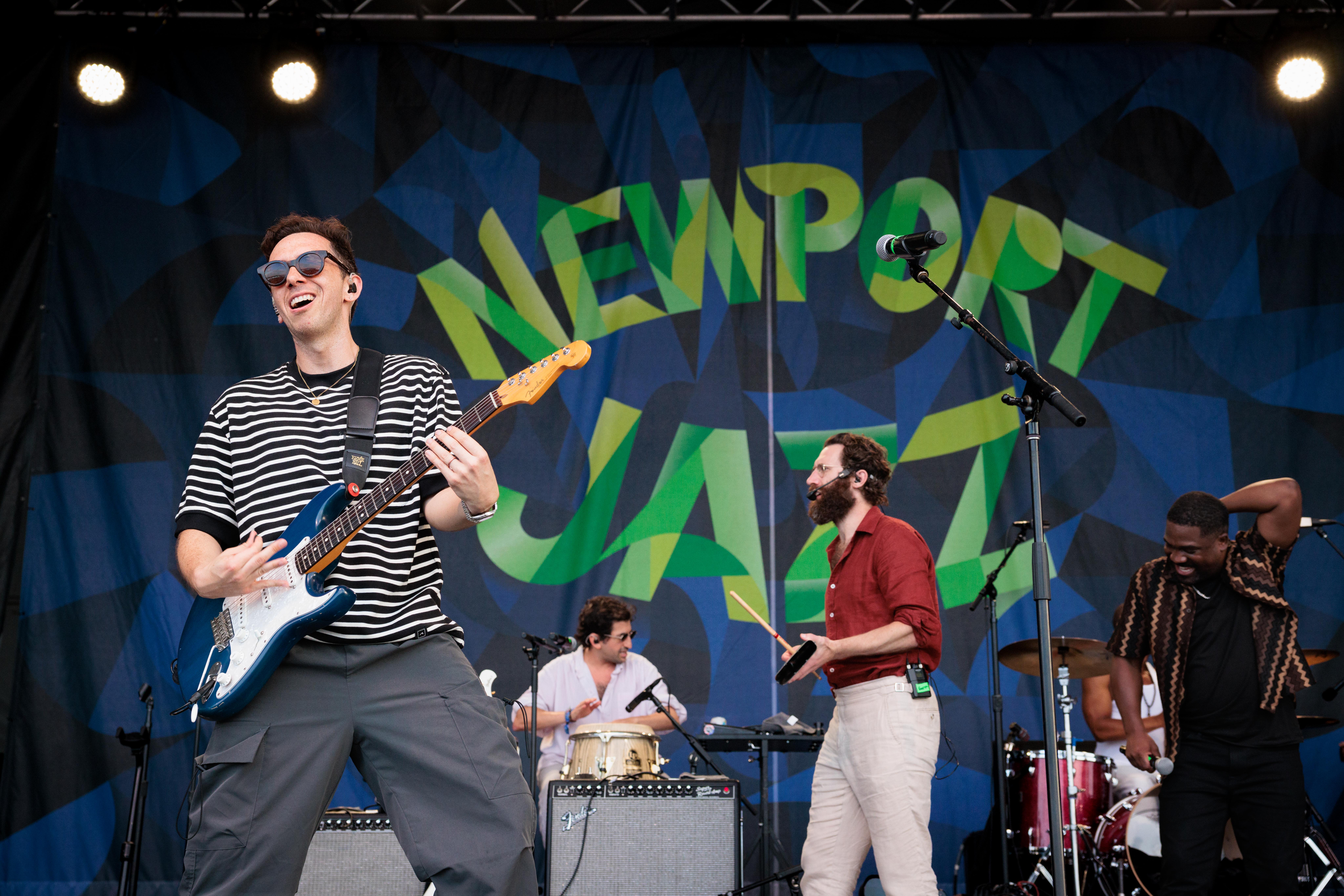
Romy Beckman: How have you been enjoying Newport Jazz so far?
Cory Wong: It’s so great. This is one of my favorite festivals. It’s a great time to hang out with so many of my friends. There; are people that I’ve never met, but we know each other from the internet, that’s one version of getting to hang out. There are other people where it’s like, we see each other once a year at some sort of festival. And then there’s just the hang that I see all over the place, all the people I see everywhere. So there’s varying degrees of connection, but the community here is great. There’s so many great musicians, so many sets. I mean, I came early every day just to come watch all the bands.

Romy: Anyone you were particularly excited to catch live or connect with backstage?
Cory: I was excited to see Nate Smith’s new band because—well, not new band, but the project that he’s doing now—I saw it a year and a half ago, and I know they’ve been on the road a lot, so they’re tour tight. So I got to hang with them, and I sat in and played with them, which was really fun.
Romy: That was an incredible set. I had never seen Nate play before.
Cory: Oh yeah, he’s insane. And Mei Simones is somebody who came and opened up for Vulfpeck on a couple of our arena shows. So I’m a fan of her music and I’ve seen her several times now, so I was excited to see her again here.

Romy: I wanted to ask you, as someone who spends a lot of time on stage, what your experience is like performing live. What is it like for you today, and has your relationship to performing live changed over the course of your career?
Cory: There’s two buckets that shows go into. Festival sets and hard ticket shows. A hard ticket show is basically just a show where it’s my name and people have bought a ticket with my name on it. And if they don’t like it, well, it’s my name on the ticket. What are you doing here? There’s a permission and there’s an understanding that I’m going to do whatever I want and I’m going to take you on the journey. You’re not going to get up and leave. You’re going to stay for the whole set and I’m going to be able to take you on the journey from start to finish.

When it comes to a festival set, sometimes people are in the front row watching you play because they’re waiting for the Red Hot Chili Peppers to get up next. And you have to win them over. Or you have to treat the set a little bit differently. Like here, Snarky Puppy and I are playing at the same time. Some people are going to watch some of my set, some of their set. They’re going to switch off and blah, blah, blah. That’s great. But how can I deliver something that’s gonna be compelling for them to take with them, knowing that they’re not going to be on the entire journey, knowing that I’m not going to be able to take them through the whole ride.
Granted, there are a lot of people that were there for the whole set. But I think there’s a certain thing with the festival environment… There are people hanging out in the background, people are walking around, people are looking at boats. People are doing other stuff. At my own shows, we’re just tuned into that. So I approach the two different types of shows differently. And I enjoy them; there are different challenges and different wins with each of them. But I’ve been doing this so much that I just love playing in front of different audiences and getting the challenge of making an artistic statement that I want to make in a compelling way for the folks that are there to listen to it.

Romy: When Vulfpeck played last night, Nate Smith introduced your show, and I thought he had a really great quote. The last thing he said before he got off stage and you guys got on was, “this is the sound of joy”. When he said that, it felt really right to me. I’m curious to hear your take on that phrase and if you think it is representative of Vulfpeck.
Cory: Absolutely. The thing that’s unique about Vulfpeck is that we’re friends first and a band second. And we also don’t play a lot of shows. A typical year is five or six shows. Every time we play, it feels special. It feels like a bit of a reunion. And we’re good friends, and we love being with each other. We really deeply care about each other as people. And we genuinely have fun doing it. So, yeah, like, it absolutely is the sound of joy because it’s a genuine feeling that we all have. We’re all so grateful to be able to do it.

Romy: I’m curious to know more about what the creative process looks like when you guys are making music, because there’s a lot of you and I imagine you all have a lot of ideas. Do does everyone sort of have a specific role when you’re making new music? Do you all do a little bit of everything? And I’m also curious how much improvisation is involved—I know you guys are famous for being a very tight band—but I’m sure there is some improvisation that works its way into that process.
Cory: This is another one to separate into two different categories. One is the studio, and in the studio… well, let me first start by saying Vulfpeck is Jack Stratton’s band. And that’s it’s his artistic vision, and we all follow his lead on that. And we each have our own role to play within that, but he is the one whose artistic vision it is. In the studio, we’ll typically send Jack different ideas, and he’ll comb through different things that we’re working on and decide on what he wants to do, what direction to take for the next project we’re doing, and we work together to make the best version of it under Jack’s leadership. But we all work together. We each get to have our own creative input and our unique voices put into it. Like some tunes, it’s not a guitar tune. I’m going to lie in the weeds, I’m gonna play my part, I’m going to add value to the song, but it’s not about the guitar. I’m going to add value; it’s not just an obligatory guitar part. But yeah, in the studio, it’s very much serving whatever the song needs under Jack’s vision.

And then live, it’s a little bit different. Obviously still Jack’s band, but he’s asked me to step in as a music director to help with the live band arranging and just making sure that everybody’s on the same page with stuff. Working with everybody to just keep things tight and make sure everybody knows what they need to know, and helping them with set lists and planning out the flow of shows. He’ll sometimes have certain ideas or moments that he wants to happen, and we build the show around those.
Improvisation versus not… to be honest, Wolpeck is mostly not. I mean, we don’t over-arrange things for the purpose of being able to do different stuff each night. Somebody does a fill here or a fill there, but it’s not like a stereotypical jam band, you know? Like, we jam, and there’s a lot of aspects and moments that are built in for do something there, do something there. But it’s not as much long-form improvisation other than a handful of moments that Joe Dart does, and a couple tunes where Joey or I do some solos.

Romy: More on the production side of things, a lot of your music is built around groove and feel, and I’m curious to know what makes a groove compelling to you and how do you know when a groove is working?
Cory: I think it hooks. A lot of people, I watch them cover Vulfpeck or Fearless Flyers or Cory Wong tunes, and they’re like, oh, they’re just jamming on A minor. Like, you’re not wrong in saying that, but we have parts, and there’s hooks. So, a lot of what we do in the group is creating hooks that are arranged with each other. Even trying to make the baseline a hook that works with the drum group, and a guitar part that sounds like a hook that goes with this or that. I think those are things that help make everything more intentional. That’s the difference between we’re playing this song or, hey, we’re jamming on A minor. It’s a big difference.

Romy: In addition to headlining last night with Vulfpeck, you then played today, your set with Joshua Redman, and then you also supported Nate Smith’s set today. Three in two days is a lot of sets. What does it mean to you to be on stage with all these incredible musicians and how your approach changes with all these different collaborators.
Cory: Yeah,and also last week, at Newport Folk, I had a set with the Fearless Flyers and a different set with Vulfpeck.
Romy: Busy couple weeks.
Cory: (laughing) Yeah, I mean, incredible. When it comes to Vulfpeck, every member of the band plays their role and they serve a different purpose on each tune. So whatever the song needs from me, I’ll do it. And there, it’s like, you’re a member of a band under somebody else’s vision, but I am music director, so I’m helping guide and make sure everybody’s on the same page for stuff. With Cory Wong, it’s my name, it’s my band. I’m the music director, band leader, I can call whatever shots I want. And obviously I take the input and creativity of everybody else that’s playing with me, but that one is just much more of a leadership role. But in all of them, I use my taste to decide how much guitar to play or not play. I like the sound of the guitar, but I only like it so much. I don’t need two hours of just shredding guitar nonstop. I don’t want to listen to that. Nor do I want to play it. So I love being able to be producer, band leader, arranger guy, and all that stuff.

Romy: On the topic of being a band arranger, I have a fun hypothetical question for you. If next year at Newport you were to play in, lets call it the Cory Wong quartet, with any three musicians from all of history, dead or alive, who would you want play with?
Cory: Ooh! Dead or alive, that’s a tough one… Nate Smith, Joco Pastorius, and Brad Meldau.
Romy: Okay. You came up with those pretty fast.
Cory: Yeah, easy. Actually, not hard at all. That’s my band. And maybe Cannonball or Maceo (Parker) on Sax. I mean, Cannonball would be really interesting in that ensemble, but Maceo… he would bring a whole other thing.
Romy: What are some albums you’ve been listening to lately?
Cory: I’ve been going back to a lot of Fountains of Wayne; it’s just fun stuff. There’s this guy Rikard From, and this album In My Own Time. Super cool. I’ve been listening to Still Warm by John Schofield. Great record. Oh, I was going back to Next by Soul Live; love that album. I’ve been on a three-year journey of just devouring the Henry Mancini catalog. Every album. Just dissecting it and just getting deep in the weeds with it. It’s been really fun.
Romy: You think that’s influenced some of your work?
Cory: Yeah, absolutely.
Romy: In what ways?
Cory: His harmony, his songwriting, and arranging of use of different textures.

Romy: Is there any aspect of your career or of your music that you think your fans don’t appreciate as much as you would like them to, or maybe the press doesn’t ask you about as much as you would like?
Cory: No, I feel like the parts that are most potent and compelling end up coming out. And if I feel like I’ve been really working on something and it doesn’t stick out, then there must be a reason. And maybe I have blind spots or gaps. Or not blind spots, but maybe certain things that don’t stand out as compelling and I’m okay with that. I’m going to constantly be learning and developing and evolving as an artist and I appreciate that I have a fan base that really is open to different sides of my artistry. It’s really fun.

Romy: That’s awesome. What have you gotten the works and what should your fans be looking forward to from you in the next couple months or the next couple years?
Cory: I just put out a live at Blue Note with Joshua Redman. We did a run of shows there. I wrote a bunch of music specifically for that band and those shows. And that’s out, brand new. I’ve been writing and recording a ton of music and just feeling really creatively charged after doing a lot of fun collaborations.
Romy: I’m glad to hear that. I’m really looking forward to all that, and I really appreciate you taking the time to talk.

Listen to Cory Wong and Joshua Redman’s On a Random Tuesday: Live From Blue Note now on streaming.
Relevant links: https://www.corywongmusic.com/, https://www.vulfpeck.com/


0 comments on “Interview with Vulfpeck’s Cory Wong at Newport Jazz 2026”